A Higher Year

On Wednesday I had a wonderful chance for three hours to get away and reflect on this past year. Our organization asks us every year at this time to take some time away and think through how we are doing – emotionally, physically, mentally, spiritually. I always look forward to the process, and in particular […]

Dinner Talk

The other day we were getting out dinner, cleaning off the table, putting Ian up in his seat, and in the midst of this din Annie said from across the room, “Mommy, are you going to get rid of me some day?”

As a mom still learning how to be appropriately sensitive to issues of adoption, I knew I needed to set dinner aside and deal with this.  Over the past six months Annie and Olivia have been thankfully very vocal about how they have been processing their understanding of being adopted.  They have both struggled at different times with why their birth mother did not want them and is not a part of their lives now.  Olivia at times has wondered out loud who her “real” mom is.  We have continued to emphasize how God has made us a forever family, and have tried to deal with things as they come up.  So this question from Annie was not one I could ignore.

I set down the dishes and went over to her.   I hugged her.  “Annie.  We will NEVER EVER get rid of you.  You are a part of our family.  We love you now; we love you forever.  No matter WHAT.”

She cocked her head at me.  “Hmm?  I was just asking if you are going to get rid of that video some day…”

I don’t know who laughed harder – Eric or me.  Funny what we think we hear at times….

Inside

Today was a special graduation party for Annie’s class, moms, and teacher. Although the graduation from youchien/kindergarten isn’t for several more weeks, this event was an important rite for all involved. And peculiarly enough for me.

For three years I have been involved with Annie’s young education — going to the school events, dropping her off and picking her up each day, participating in cleaning days, some play dates, trying to help her build friendships and become more integrated into the system. But unlike Owen’s early school years, I never felt a part of the group of moms. And I don’t think Annie has, either. Until today.

When Owen was in youchien, there was a mom friend who brought me into the mom group – she made a point of including Owen and me in special events, BBQs, play dates. As a result, I was able to build more friendships that are still strong today.  I think, too, that Owen more naturally and quickly entered into the culture and language than Annie which has made a difference.  At any rate…

My one good friend in Annie’s class, N., was one of the co-leaders of this graduation party. She asked me to be in charge of games — and to feel free and go all out “American-style.” LOVE the challenge! I asked two of the moms who are studying English with me to form a game working committee. Yesterday, after earlier discussions, they came over and we worked on the games for several hours. I learned several things as I reflected on these past few days’ events:
1) The process is SOOO important. Even though the games were ones I have done numerous times before and could have led on my own, it was essential that our committee of three laborious discuss each detail together, and arrive at conclusions as a group for even minute issues like what to name each game; what colors to use; how many balloons each team should get. At the party today, we were a unified team. Of course there were glitches (a little boy throwing up, for example);but it was natural to work together (funny – it was the three of us who cleaned up the little boy’s mess, even though we had been sitting across the room when it happened. We were a team!). In this culture, the process is probably more important than the end result. We were in this together.

Often as a North American I am tempted to skip over much of the process in order to be more expedient –i.e., I know how the games work- that’s all that matters–let’s get it done! But if you take the time to go through the process….

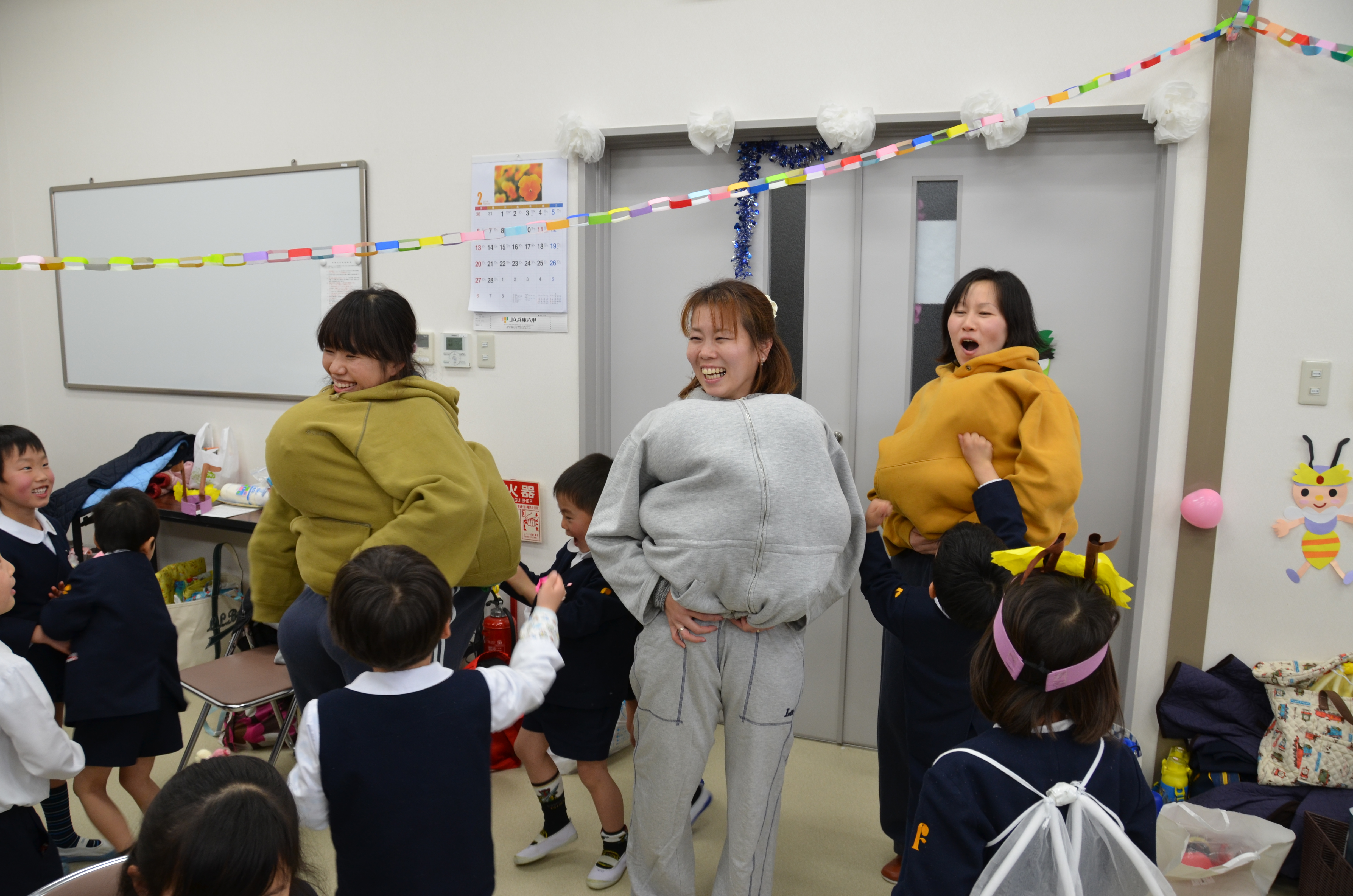
Here’s a few pictures from our games:


2) In Japanese culture it usually takes someone on the inside to pull you in from the outside. (The exception that I have found in my studies is when you are part of starting something new — if you are all newbies, you often get the advantage of starting on the inside). My friend N. asking me to do games was in some ways a risk for her. But as a result, I started getting texts from other moms; moms starting calling me by name (instead of just “Annie’s mom”); today there was a tangibly different feel with the moms as we hung out, side by side; peers.

3) It’s not about being popular. Of course I struggle with wanting to be accepted, but I gave up expecting too much in that regard  a long time ago. But being brought inside in any group in Japan is a huge step towards adjustment in whatever phase of cultural acclimation that one is in; it absolutely helps fight the isolation that sends many missionaries packing after too many lonely years here.
4) Our indepth involvement in the activities and more importantly in the lives of our community friends helps our children with their own adjustments and identity issues as Third Culture Kids.  Annie has made great advances in recent months in language learning and friendship building;  I want to continue to do all I can to help her in this area.


5) The goal isn’t to be inside; rather it’s to build relationships in such a way that Jesus can be experienced as real. And as I go deeper in my friendships with N., my two mom friends who helped plan games; the teachers and other moms, it allows me the advantage of being up close and personal… and hopefully therefore Jesus, too, having a chance to be up close and personal. This is my prayer.  Yesterday during lunch one of the game committee moms starting crying as she shared about some challenges she had with her son.  I had NO idea.  Now I know;  now I can pray with her.  Jesus is all the closer to being able to enter into her world.

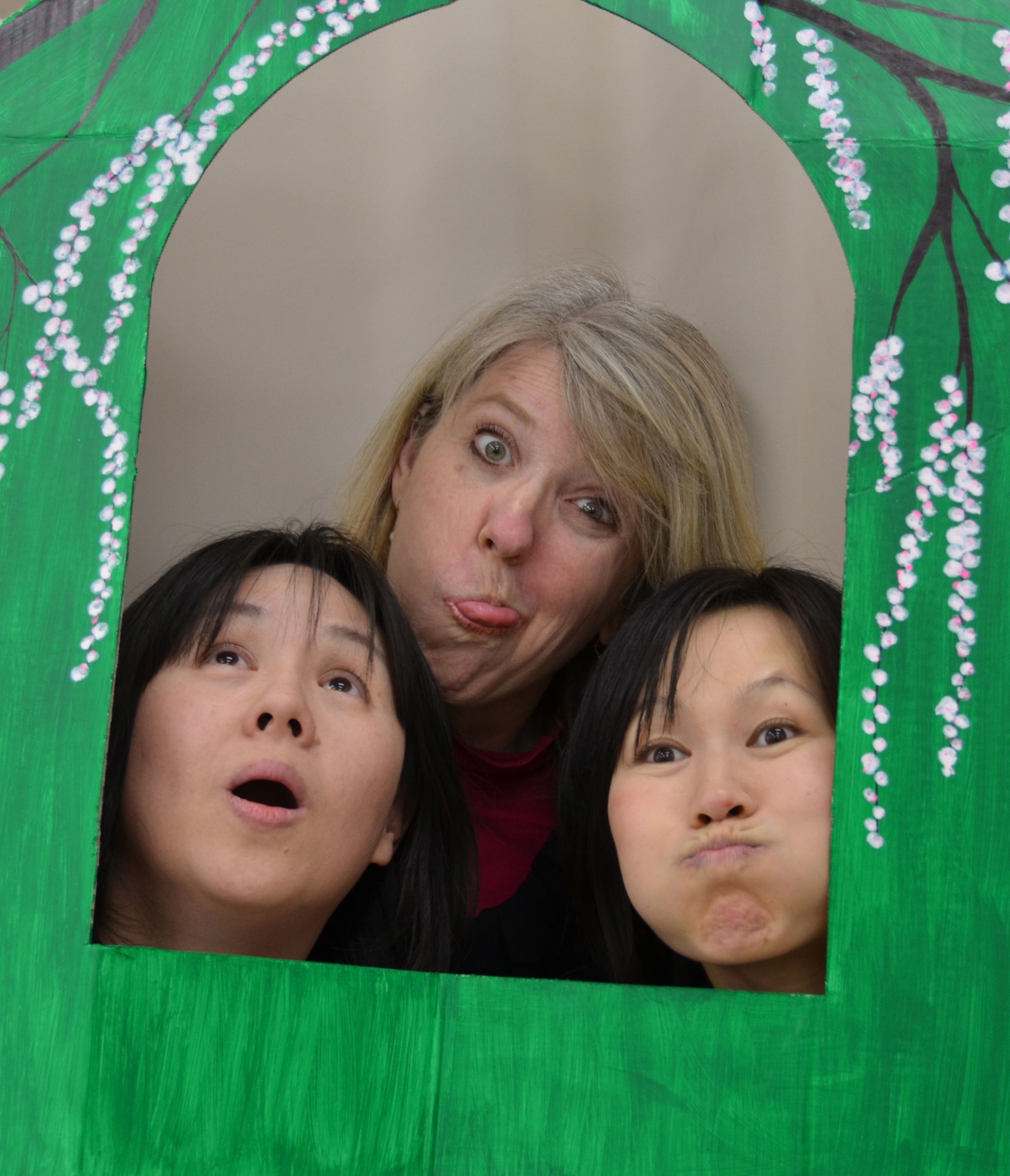
6) It’s strange but when we feel accepted we are more able to be ourselves. For better, or worse. You should have heard all of our kids crack up when they saw these last few photos!

7) Final lesson – don’t show a one-year old a picture of his mom sticking out her tongue. Someone has learned a new trick.

Lasting Legacies

One of my favorite stories that illustrates God’s power to change many lives through the life of one is that of Kazue.
Kazue-page-10
 Part of my master’s thesis was a leadership study on the life of an Irish missionary in Japan, Irene Webster-Smith.  I learned soo much researching her life as a leader, her ministry, her methods of sharing about Jesus with the Japanese. I studied her life through old newsletters and pieces of biographies. I was particularly interested in the results of Irene’s influence on Kazue.
Kazue was nineteen years old when she met Irene, who was ministering not far from here before World War II. When Kazue came to Christ, Irene prayed that Acts 16 would be true- that God would save her and her household. Her governess was first- the next day!  Over the next six months, all seven of her siblings came to know Jesus.  And then her mother.  And her dad, the President of the Osaka Stock Exchange.  Her dad then confessed that he had had a geisha lover.  Irene went and shared Jesus with her;  she became a geisha missionary in Kyoto to other geisha women.

Kazue married a Christian, but moved in with his non-believing parents.  While he was at work, his mother would lock Kazue in a closet all day because she refused to bow down to the family Buddhist altar.  As a result of this abuse, Kazue got tuberculosis, and died at the age of 23.  At her funeral, the mother-in-law came running up to her body, screaming, “I’m sorry I killed you!”  Everyone was stunned.  As she looked around the room, she realized that Kazue never told anyone about the abuse.  She had even kept the fact hidden from her dear mentor, Irene. Kazue’s mother-in-law and father-in-law, too, became followers of Jesus. (Photo below was Kazue after she had passed away).
Kazue-page-8

A small book was published in Japanese by Kazue’s dad about her life, based upon Kazue’s own journals the last few years.  There are some neat stories that I found about that book that went out as far as to Korea. As I researched Kazue’s short life through limited English resources, I discovered over fifty people who came into God’s Kingdom as a result of one college student who chose to follow God with her whole heart.
*************
I shared this story on the first morning with the class I am teaching. When we met again two weeks later, one of the students, Eiji-san, brought in the most amazing “show and tell” – a first edition copy of Kazue’s book. Inside, was a letter that Kazue had written to perhaps her pastor at the time…
Kazue-page-1
I can’t describe the words I felt as I held the book and the letter in my hands. I have copied the photos that were in the book, and loved reading the forward from Irene Webster Smith.
Kazue-page-3
Kazue-page-2

We showed the book and letter to our close friend, Y. She couldn’t put the book down… she has been reading it the past week, and asked her mom to read and help understand the letter, which is somewhat antiquated Japanese. She translated one of the short “poems” that Kazue wrote during her time of suffering:
“Everything God does has meaning; He never fails.
When things seem to go wrong or to be fruitless, it is because our faith is not strong enough, not because of God’s failure.”

Truly – He makes all things beautiful… I marvel at how God is still using the life of a 23 year old who passed away without children more than seventy years ago. When we think about what kind of legacy we will live behind – I think of this young woman. She loved God with her whole heart; she couldn’t help but share about His goodness with all those around her. The rest – is history.

When Ear-Pulling Doesn’t Work

It has taken me almost three months to finally finish grading the papers from the Leadership class that I taught in the fall.  They were mailed to me, then I had to send them to the translator, who went through and gave them numerical marks, then she sent them back to me where I went through and put comments on them.  One of the pastors whose heart and spirit touched me so much had shared a story in the class about his first day at his first job as a fifth grade school teacher at a public Japanese elementary school.  I asked him if he would write out the story for me;  he had enclosed it with his final paper.  The other night a friend and I went through and translated it.  As a parent;  as a teacher – I can learn a lot from this story.

In April 1977, it was my first morning as an elementary school teacher.  Since the gym was under construction, we were supposed to have the opening ceremony on the playground instead of inside.  I was looking at the list of students before the ceremony.  Then a lady teacher came over and she looked at my list, and she said, “Oh, this is the boy Shinji who is a trouble-maker.  I’m betting he makes trouble for you all year.  He’s not easy – he’s really hard to control.”

I thought, hmm.. I wonder what kind of boy he is.

It was a very hot day.  The principal told all the students to sit down while he was talking.  There was a teacher with lots of experience standing with his arms folded, walking around the perimeter.  So I did the same thing.  The other teacher found Nishio-kun from the other class, sitting on the ground and drawing in the dirt.  The experienced teacher went over, yelled at him to listen to the principal, pulled his ears really hard, and forcibly turned his head around to face the principal.

I watched all of this from behind.  Suddenly I found that my eyes met Nishio-kun’s eyes.  I could tell he was not repentant, but rather was mumbling to himself a response.  I thought to myself, “Oh, that wasn’t a good way to correct his behavior.  Now Nishio-kun has to start his first day of fifth grade like this.”

Suddenly I saw Shinji-kun sitting right next to Nishio-kun, drawing on the ground.  Nishio-kun was looking at me and Shinji, daring me to come get it.

I didn’t know what to do.  I knew I had to do something, but I didn’t want to pull his ears.  So I prayed, “dear Jesus, please show me what to do.”  After that, as I passed by Shinji-kun, I bent down and said to him, “Wow, I think you have a gift for drawing.”  I didn’t wait for a response, but continued walking.

After the ceremony, the children and I went to our new class.  I talked with the class about my expectations for the class.  After the first period, I was sitting at my teacher’s desk.  Shinji-kun came up between me and the desk and sat down on my lap.  Shinji-kun brought his face right up to mine, within ten centimeters, and looked at me directly.  He said to me, “Teacher, I think I can do good this year.”

Everything, in fact, went quite well that year.  He was not a trouble-maker, but rather was willing to help me a lot in the classroom.  I found out that Shinji-kun did not have a mom, but his father was so happy with who Shinji-kun became that year in my class.

The E. Word in Japan – Even a Lump of Ice

The past few months I have been reading, thinking, breathing, talking a lot about the topic of the course I’m teaching in Nagoya – evangelism.  It’s something I’m pretty excited about;  it has been been  refreshing and challenging to attempt a comprehensive study on this topic in Japan.

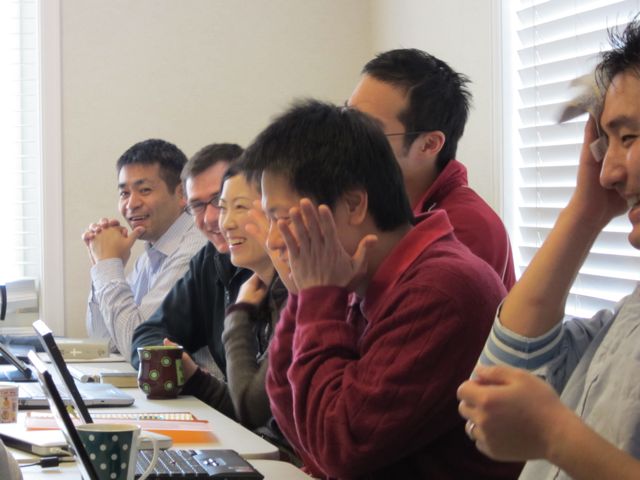
Yesterday I taught a full day at Christ Bible Seminary in Nagoya  — 4 lectures/topics to about twelve students:  1) Irene Webster-Smith and the Power of One (focusing on the amazing things God can do in Japan through changing one life in the context of their community); 2) Paradigm Shifts and Conversion – looking at different types of paradigm shifts and models to help us understand what happens, including the need for dialogue instead of  monologue;  3) Hindrances to Evangelism in the church in Japan – this was interesting because due to miscommunication the lecture handouts never got translated.  But I really think it was better that this was not a lecture with “answers” coming from me – I allowed the class to brainstorm and discuss together, coming up with a great list -they hit many that were on mine;  4) A Theology of Relationships – looking at how God’s heart, mission, and strategy is centered on restoring and building relationships, and our strategy should likewise reflect His.  We focused on the need for the church to better equip lay people to build relationships to do evangelism, and the need to help people experience the realities of Jesus in the context of those relationships.  Here’s some of our class.  (Thanks to Craig for these photos.)

I loved how the class entered in!  One of the things I like to do sometimes when I start a class is to have students write a haiku (5-7-5 syllables).  Some of the students afterwards said this might have been the most difficult assignment that I give out! – but I was touched by what the students wrote about their perspective on evangelism in Japan.  Here are a few:

1)この日本は 2) まことの神を    3)知りません。  Translation:  In this Japan   they don’t know the true God.

1)しゅうかくは  2)ゆたかにくるよ  3)にほんにも。  Translation:  The harvest is really coming in abundance even to Japan.

1) Waiting quiet lake  2)  God’s hail drops hit here and there  3) ripples, touch each one.

1)御言葉を  2)すべての民に  3)世の民に        Translation: (Taking) The Word  – to all people, to all nations of the world.

1)  In the Book of Acts  2) You have promised us power  3)Please give us power.

1) 氷塊も    2)主の御言葉にて   3)川となる。 Translation:  Even a lump of ice — the word of the Lord can make it as a river.  (Psalm 147:17,18)

The M. Word

This weekend I heard from my sister about a high school friend that she ran into recently.  We hadn’t been in touch for awhile.  She had heard recently that I was working in Japan, and she wanted to confirm with my sister what I was doing.  When my sister told her I was, indeed, a missionary, she had that sort -of disgusted-no-way! look on her face.  That look, “that-is-so-unfair-to-go-and-cram-the-Gospel-down-the-throats-of-people-in-other-countries” look.  My sister shared about the chance she had to come and stay with us for awhile in Japan, and that it completely changed her image of what it means to be a missionary… how people from our local community would come into our home and find a safe place where they are loved, rather than a place where they are judged.  My sister said this seemed to help, but….

That afternoon I was in the car thinking about it all and couldn’t help the big tears rolling down my cheeks.  I was trying to figure out why it affected me so much.  I guess first, it stung to feel the condemnation of a friend whom I have always really respected.  And then I realized that we are doing here is not just our job – it is our LIVES.  It is a calling that we have left everything for because we believe it – no,  because we believe that HE is so so worth it.

As I processed this with Eric, he helped me make more sense out of it.  What is a bit hypocritical is that this friend and her family are in a believing church, and very much, I believe, a part of it.  So Christ is real to them, and obviously makes a difference, or why would you “do” church?  So doesn’t it make sense to want other people to know about this good find?   If you find something good — don’t you want other people to know about it?  This is oversimplified, but if Olivia finds one lollipop in the snacks box, she isn’t going to tell her siblings – that is for sure.  But if she finds a whole PILE of lollipops – and there is a note attached that says if you give these away you’ll get even more amazing snacks — who’s going to hide that?   And who’s going to judge her for giving away some of that pile to people who might also want to partake once they know about it?

In preparing for the class I have been teaching, I have read a lot about some of the  earlier “colonial” type missionary methods that perhaps helped to create the stereotype of missions today.    The missionary movement one hundred years ago placed a huge emphasis on confrontation and proclamation, without much thought to cultural contextualization.  Thankfully, the tide of the missionary movement has significantly changed towards contextualizing the Gospel (keeping the message of the Gospel but having it make sense for the culture in which it is being shared),  incarnational witness and engaging in dialogue.

This is where our hearts are.   We want to live among and love the people in Japan.  Through dialogue and sharing our lives together, we want them to know that they are loved by the Savior of the World. We very much want Japanese believers to experience Christ in the context of their culture.  We want the churches in Japan to reflect this culture, not the western one that first introduced Christianity.  Paul Hiebert writes, “We must go where people are, speak their language [help me God!], and become one with them as far as our consciences allow and we are psychologically able. People need to hear the gospel in their heart language and see it lived in us.  Incarnational also means, however, that there is something outside their language and culture in the gospel and its messengers.  Felt and real needs… Today we realize we may need to start with felt needs, but we must move to the ultimate needs which the gospel addresses:  salvation, reconciliation, justice, and peace.

I have been wrestling this past month with the idea of proclamation.  We are still learning and have a long way to go, but I think we have done fairly well at incarnational ministry.  But we have to always remember that there needs to be a place in all of our relationships where those we love have a chance to hear — or better yet – experience the Gospel.  To see with their own eyes, to hear with their own ears, that it is Jesus Christ who makes a difference.  We can be all about loving people, but if they don’t know that Jesus is our message;  if they don’t have a chance to make a choice to know Jesus, then in essence we haven’t completed our intentions – we haven’t shared our lollipops.    We pray for opportunities of need to open up that allow us to both show God’s love and pray with people for those needs.  This is great. But I also sense the Lord wanting me to be more bold with this good news… “For how can they know if they haven’t heard?”

Any thoughts?  I’d love to have you process with me through some of these ideas.

The Race

This afternoon I made a quick decision to leave today for  Nagoya instead of tomorrow morning, after hearing that we may be hit again with a crazy snowstorm like two weeks ago.  I am still wondering if this will affect the classes I am supposed to teach tomorrow.  Because of the day being cancelled the last time, I am scheduled to teach an extra class, going from 9:30 to 5 tomorrow.  Please do pray for me and for this class — I can’t think of a more important subject for students in seminary (or any of us in Japan) than that of evangelism.  (Blogging to follow!)

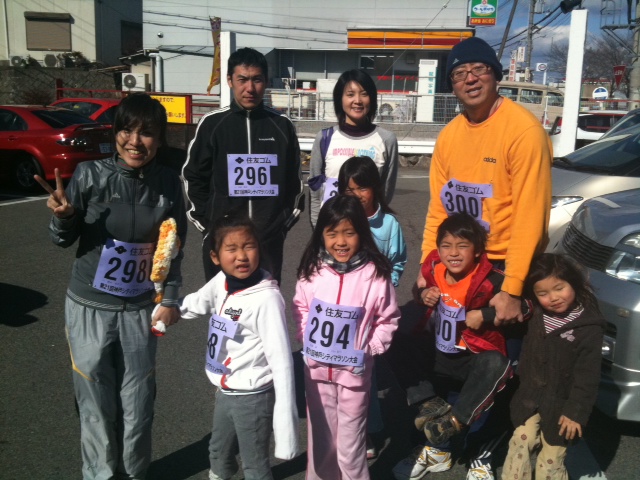
This morning our family got up early and headed in a different direction – south — to Kobe.  We caravanned with two families from our neighborhood to participate in the parent/child Kobe City Marathon (the word marathon, when used in this country just means a race, rather than 26 miles!).  Owen and Eric, and three other parent/child pairs who live near us all ran the 1.5 kms.

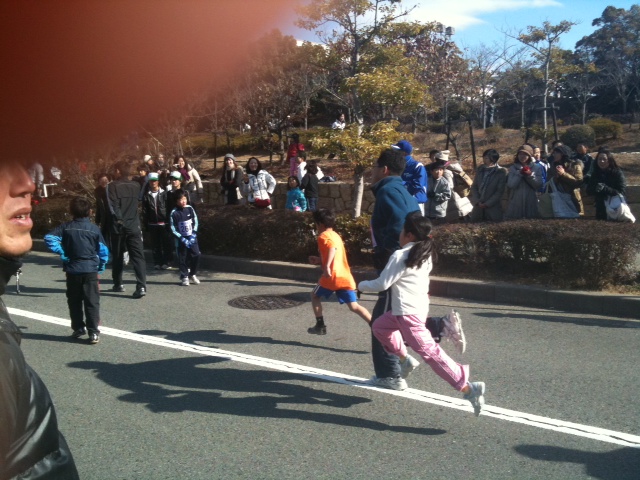
The younger three kids and I, and one of the grandmothers from our neighborhood had just started waiting at the finish line.  I watched a number of father or mother/child pairs come around the bend, hand-in-hand, and realized it was a pretty short race.  I started to get out my iPhone to be ready to take a picture when Annie yelled, “Hey – there’s Owen!”  I hadn’t seen Eric yet- so I was surprised, and just managed to get the back of him as he headed across the finish line (wearing the orange shirt).  Without Eric!
A few moments later we saw Eric, focused on the orange shirt running in front of him.  They met up after the finish line.  (So – I have no idea why that picture just came in sideways – but I’m too tired to try and change it.  Sorry!)

The race officials had given a sensor for each of the parent’s to wear on their sneaker, and Eric’s showed that they (or he at least) had come in 32nd (4 minute 45 second kilometer). If Owen had been wearing it, they would have been at least 25th…

Eric said when they started out Owen wanted to bolt, as he usually does when they’ve gone jogging at the beginning.  Eric told him just to go, assuming that Owen at some point soon would grow weary and slow down, allowing Eric to catch up.  It never happened.  He was one dashing boy, all the way across the finish line.  Technically they were supposed to hold hands across the finish line, but I don’t think that partnership was on Owen’s mind as much as getting across the finish line as fast as he could.

It was great fun to celebrate with our good friends as they came across the finish line, too, and then to all caravan back to Sanda and enjoy steaming bowls of hot ramen noodles together.  It was a wonderful time for community building and enjoying friendship.

On the way back in the car, as Eric was telling me about Owen sprinting on ahead, I thought that it is often harder than one thinks to stay hand-in-hand with our Japanese and ministry partners.  We have our eyes on the same goal – and that is good- but at some point along the way we drop hands and forget that the plan is for us to be going at this together.  We still get across the goal, but it may not be with all that God intends it to be.  In some ways I think as North Americans we are so used to doing things for ourselves;  setting our own goals and course, and going for it. And Japanese are not always sure quite how to link arms with North Americans.   Alone, we can each get there faster perhaps.  But without all the benefits that come from linking arms with those God has called us to partner with.

We continue to pray for God to show us with whom, and how, He wants us to partner here in Japan.  To perhaps slow us down;  or redirect us, so that we maximize all the benefits of running this race together.

Six hundred minutes

This morning when I woke Olivia up for school, she looked at me very hopefully and said, “Mommy, just one more morning-time and then Daddy is coming home?”  (Eric has been spending time with his family and helping his brother get moved.)

I like the way kids count.  Tonight Owen asked before bed how many minutes until morning.  I said I didn’t know how many minutes but about nine or ten hours.  He went to his room and then came back to where I was tucking in the girls and said, “How many minutes are in an hour again?”  “Sixty.”  I hear his mind working.  “So how many minutes would that all be?”  (Still working on the multiplcation tables!)   “Six hundred minutes, Owen.”

“That’s too long!  That’s too many minutes!  That’s not fair!”

I promised him time would fly very quickly between now and all those minutes if he did what I had asked and jumped into bed.

It’s been a really good eight days with the kids – I think we’ve all done well — until today.  For me.  I’m ready to have him home.   Tomorrow night after a dance practice, sports club, Olivia’s play date and a quick dinner we will all drive to the airport to pick him up.  Meanwhile, those minutes are just ticking away … but – they must have woken up Ian because I hear him crying out upstairs.    Thankfully, just one more morning-time and then Daddy comes home!  Woo hoo!

Kyoto

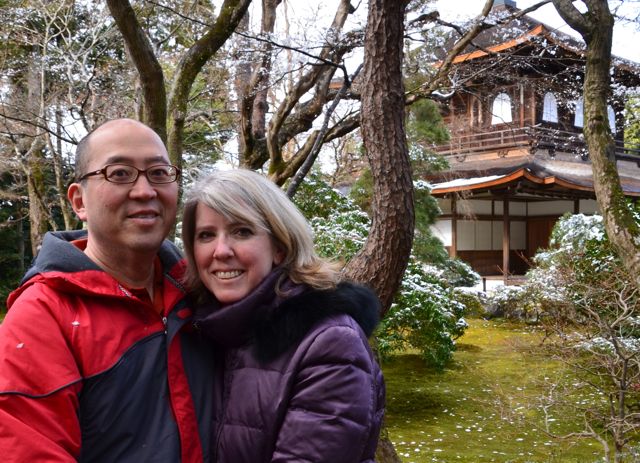
Ten days ago, Eric and I had a chance (made the opportunity?) to get away – a month late –  for our thirteenth anniversary celebration.  I’ve finally had time to download our photos!

In recent years we’ve found a get-away more likely to happen if we try and do it in January.  So, the last night before our kids headed back to school from winter break we went to Kyoto, thanks to the gracious help of friends who watched our children overnight.  It was such a wonderful trip!  On Sunday night we chose to eat at a small izakaya called Issei which served a unique, delicious dinner cooked in front of us on a black stone.  After some delicious delicacies we meandered through the crooked romantic streets still haunted by geisha and meiko.

The next morning, we were thrilled to see the city covered with a soft cottony snow.  Snow somehow helps make cold more bearable.

We decided to go and see the ginkakuji temple – the silver temple built five hundred years ago that was supposed to be plated in real silver — until they ran out of money.  It was stunning in the snow.

Just before we left our perfect get-away, we met a beautiful young woman celebrating coming-of-age in one of the most beautiful of cities.  Isn’t she wonderful?

I wrote briefly tonight on Facebook about a discussion that came up in my ladies’ English class.  We were sharing about our favorite restaurants, and who we like to go there with.  My friends in the class were all amazed that I said my husband.  None of them ever go on dates with their husbands.  Like —never.  Period. Later, while having dinner with family friends in our neighborhood, the wife and I were talking about this nationwide marriage problem.  And she said, “Aren’t you so thankful that you married Eric?”  I can only say, like thirteen years ago – – Yes!  We are still learning and growing in our marriage, but I thank God every day for this humble and godly man He has given to me.